
As squadrons of Japanese planes approached the island of Oahu on the morning of December 7th, 1941, they were poised to attack a nation divided. Approximately 80 percent of the American public hoped to completely avoid what they termed “The European War.” Notable among the reasons for this hesitation was recollections of the Bonus Army March of 1932, when American veterans of the First World War marched on Washington to request their promised military bonuses early but were forcibly removed. The song, “Brother, Can You Spare a Dime,” written a few months later, gave voice to their sense of abandonment.
So why should America help Europe again?
Then the bombs fell and 2,400+ US military personnel were killed as well as 50 civilians. Imperial Japan did not intentionally target the general population, but Americans, reeling in shock, didn’t know that. Invasion fears were soon replaced with a determination to fight back and the national hesitation regarding involvement in the war all but dissipated as half a million young Americans signed up for the military.
The bitterness of the WWI veterans was forgotten as the new generation drew inspiration from the heroes of that war as well as the song that had roused the nation to fight in 1917: George M. Cohan’s “Over There.”
Despite this rush of patriotic enthusiasm, the United States Office of War Information, the OWI, felt compelled to find the “Over There” for this new war, a song that would maintain enthusiastic participation long after the initial rush of excitement began to ebb, a song that would keep the boys signing up and their families supporting them while they endured the privations of war on the homefront.
American songwriters responded to the attack—and to the government’s challenge---with a flurry of activity, producing more than 1,000 anti-Axis songs in the weeks following Pearl Harbor:
For instance:
“We’ll always remember Pearl Harbor”
“Let’s put the axe to the Axis”
“The Sun Will Soon be Setting for the Land of the Rising Sun”
“To be Specific, it’s Our Pacific”
“Let’s Knock the Hit out of Hitler”
And my personal favorite:
“Put the Heat on Hitler, Muss up Mussolini, and Tie a Can to Japan.”
Obviously, none of these caught on in a big way.
“We Did it Before and We Can Do it Again,” written on December 7th, 1941, enjoyed some early success, but within the year, it was eclipsed. Four months following Pearl Harbor, Frank Loesser, lyricist to Hoagy Charmichael’s “Heart and Soul,” wrote the following in a letter to his wife: “I have a title…which is a quotation from a news story a few months ago---a sentence supposedly spoken by a brave army chaplain.” The story that had inspired Loesser, as it was initially reported, went like this:
“As sailors boiled from below decks of a US Navy warship to fight off low flying Japanese planes, Chaplain William McGuire left his altar where it stood and ran to a gun station where one of the gunners had been killed and another wounded. In the unholy uproar of that torrent of bombs, Chaplain McGuire shouted his now famous words: “I just got one of them!! Praise the Lord and Pass the Ammunition!!”
That’s not exactly what happened Months later when Chaplain McGuire was interviewed by LIFE Magazine, he admitted he didn’t even recall saying those words, and if he had, he said, “Nobody could have heard me in the din of battle.”
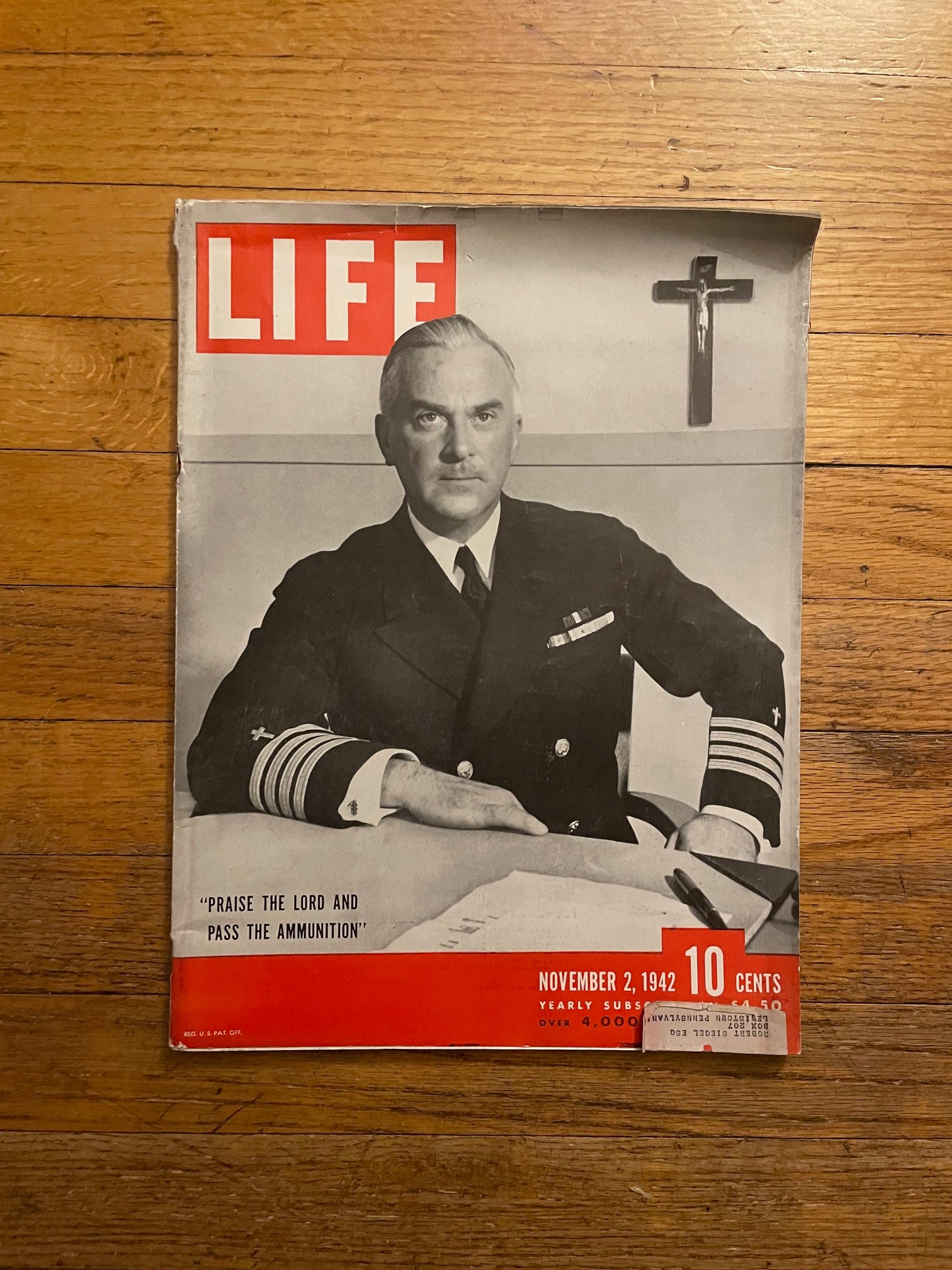
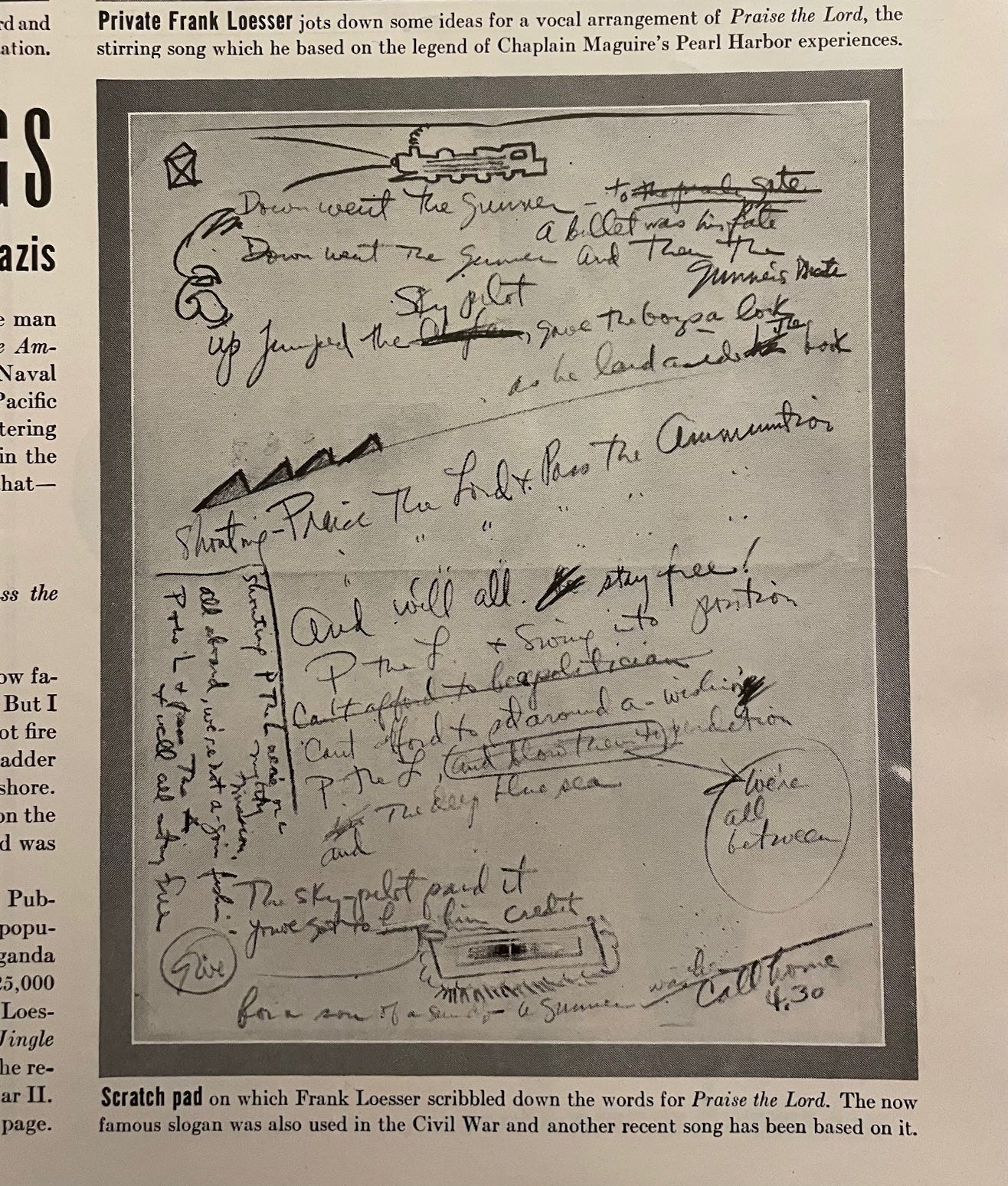
But Loesser, who wrote the song long before the article came out, seized on the initial story, creating the following lyrics to tell the mythical tale:
Down went the gunner, a bullet was his fate.
Down went the gunner, and then the gunner’s mate.
Up jumped the sky pilot, gave the boys a look,
And manned the gun himself as he laid aside the book, shouting
Praise the Lord and pass the ammunition
Praise the Lord and pass the ammunition
Praise the Lord and pass the ammunition and we’ll all stay free.
This song debuted in NYC at the famed Leon and Eddie’s Nightclub sometime in 1942, recorded by the Merry Macs that same year, recorded by Kay Kyser and his orchestra in 1943. One million disks of Kyser’s recording sold as did one million additional copies of other artists’ recordings.
The OWI felt they had found their song, so much so that they prohibited it being broadcast more than once every four hours, hoping to extend its galvanizing power—they didn’t want enthusiasm for the song to wane during what they suspected was going to be a long war.
But years before Frank Loesser’s big hit galvanized America, Irving Berlin had already written the takeaway song of the war.
“White Christmas” was heralded on a Monday morning, January 8th, 1940, when its creator rushed into his office uncharacteristically early and said to his assistant, “I want you to take down a song I wrote over the weekend. Not only is it the best song I ever wrote, it’s the best song anybody ever wrote.”
But if it had been born that January morning, “White Christmas” had been gestating since mid-1938, when Berlin jotted down its title and threw it into his pile of ideas he referred to collectively as “the trunk.” “White Christmas” was originally intended to be a loud, rousing finale sung by a full chorus in a never-produced musical called The Crystal Ball.
So when Berlin blew into his office claiming to have written a song over the weekend, it might have been more accurate to say that he pulled something out of “the trunk” and tinkered with it, bringing it to a completed state.
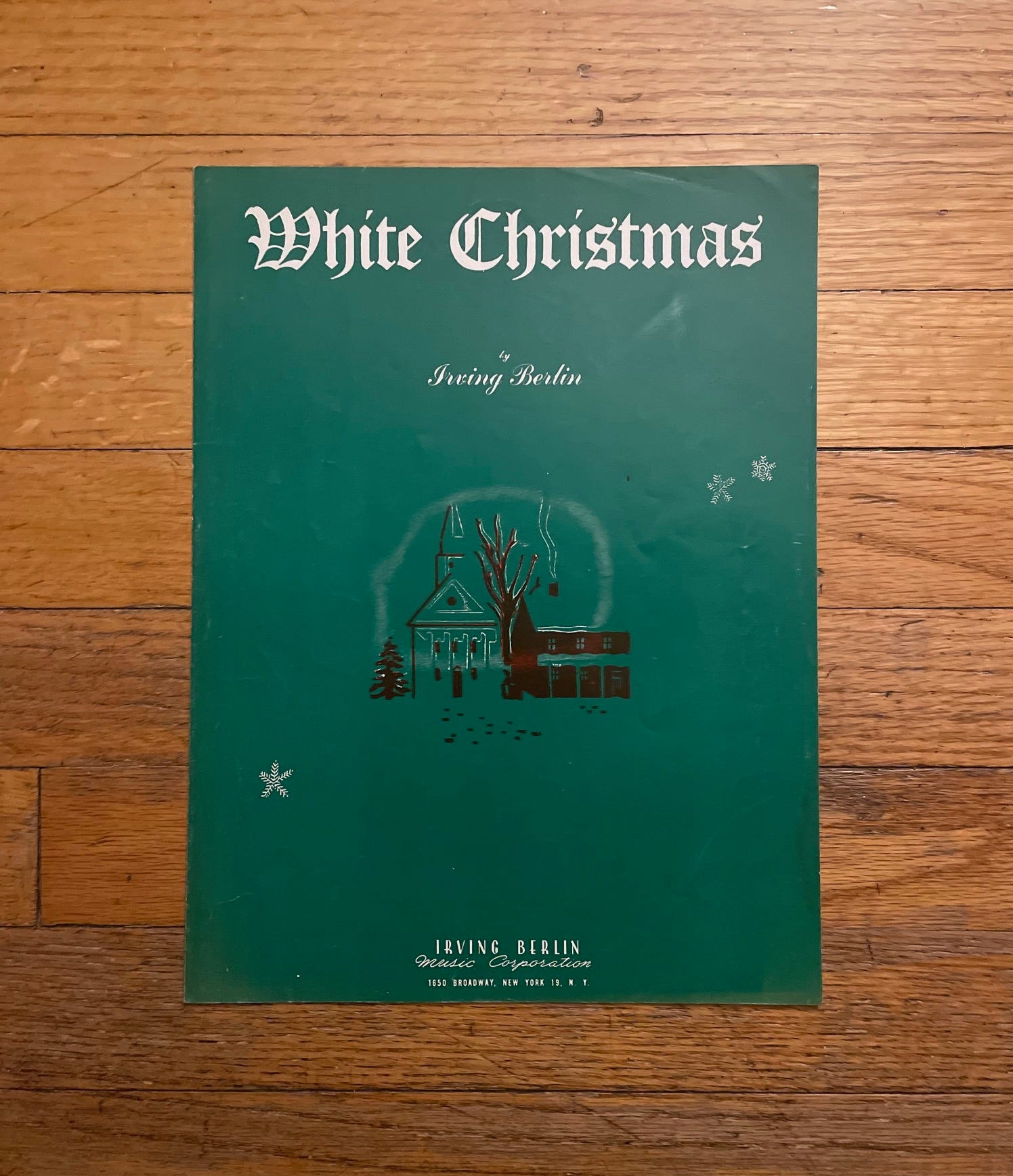
Berlin kept “White Christmas” a secret but he had great plans for it. In April 1940, he met with a Hollywood director, presenting a film idea that would feature a song and dance man whose country inn was open only on holidays. And Berlin insisted that Bing Crosby—the American voice of Christmas since his 1935 recordings of “Adeste Fidelis” and “Silent Night”— would star in the film.
On Christmas Eve 1941, 17 days following the Pearl Harbor attack, Bing Crosby debuted “White Christmas” live on the radio. The public can be forgiven for not registering the song at the time—they were gearing up for a war. And much to Berlin’s disappointment, “White Christmas” also did not register when Holiday Inn premiered in NYC in August 1942.
But the following month, Billboard reported that the song was climbing the charts. By December, Crosby’s recording had sold 2 million disks.
Why was that? Berlin claimed to know: “The boys overseas are buying it.”
His song reached the boys 1) through the Armed Forces Radio request programs. 2) played on the jukeboxes in USO halls and PX stores. 3) Crosby’s recording was also included in recreation kits received by the young men in uniform.
While entertaining the troops during the war with the USO, Crosby was frequently asked to sing “White Christmas”. “So many young people were away,” he said later “and they’d hear this song…and it would really affect them. I sang it many times in Europe in the field for the soldiers. They’d holler for it; they’d demand and I’d sing it and they’d all cry. It was really sad.”
Perhaps the young members of the Greatest Generation whistled “Praise the Lord” while they were standing in recruitment lines, enduring boot camp or even on the battlefields of Europe and the Pacific. They would have sung it from a place of confidence and determination that if they remained at their position, “they would all stay free” as the song went.
But “White Christmas” put them in an entirely different state of mind. Perhaps these young warriors wept when they heard the song about December 25th, a day that during their childhood had seemed full of magic and miracles.
And while those memories brought tears to their eyes when they were so far from home, many for the first time, it might have also provided them with a more profound reason to stay in the fight. Staying free was the goal expressed in the Frank Loesser song. Irving Berlin articulated the point of that goal in his song: defeating fascism meant living in a world that had room for the quiet beauty of Christmas.
“Praise the Lord” was too specifically tied to a particular event to be embraced by anyone who hadn’t lived through the terror of the Japanese attack on Pearl Harbor.
But the Christmas song born during that war still has the power to fill us with an intense nostalgia for an idealized past as well as hope for the future: that we might live in a world of peace where each day has the potential of being merry and bright, where all our Christmases, if not white with snow, might overflow with warmth, love, and light.
References:
Bush Jones, John. The Songs that Fought the War: Popular Music and the Home Front, 1939-1945. Waltham, MA: Brandeis University Press, 2006.
Rosen, Jody. White Christmas: The Story of an American Song. New York: Scribner, 2002.
Smith, Kathleen E.R. God Bless America: Tin Pan Alley Goes to War. Lexington, KY: University Press of Kentucky, 2003.
LIFE, November 2, 1942.


No comments:
Post a Comment